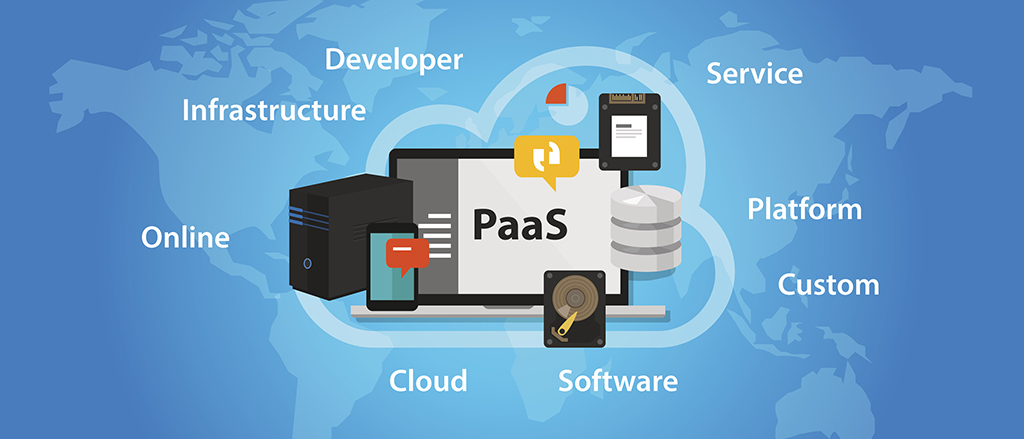
The full form of PaaS is Platform as a Service. This model offers hardware and software tools from a third-party provider through the cloud interface for E-Commerce platforms. Usually, these tools are essential for software development. Third-party providers host the hardware and software tools. This results in the advantage of not handling any physical hardware or software on-premises. This also lessens the burden of timely updating of various software.
PaaS computing models are developed to run simply and they are very convenient to use. In this model, users have to pay-as-you-use(PAYU). The main advantage of this model is its control because only hardware and software tools are hosted by a third party but the management of those tools is done by the end user. In 2017, the usage of the PaaS computing model was 32% it is expected to grow by 56% at the end of 2021. This makes the PaaS cloud computing model the fastest-growing model for E-Commerce. The PaaS model market is estimated to reach $216 million by 2022.
Advantages of the PaaS cloud computing model
Time-saving
In the PaaS model, there is a faster installation of hardware and software tools because you don’t need to purchase and install the hardware and software tools on your premises. You simply have to opt for which PaaS model services you have to use and which hosting vendor you are choosing. Then you simply need to log in to the hosting provider.
A wider variety of resources
The PaaS model offers a wider variety of software and hardware tools to choose from like databases, middle-ware, operating systems, and development tools. This model is cost-effective too because the charges are paid on pay-as-you-use(PAYU).
Experiment with lesser risk
As the tools are hosted by third-party providers you can test various languages, operating systems, and tools and then decide which tool is favorable for your business.
Accessibility
This model provides a shared software development environment that allows the development and installation of tools around the globe regardless of location or time. The only important thing is the availability of the internet.
Overall cost-effective
Overall PaaS model is cost-effective because you don’t have to invest in capitalized expenses of installing and maintaining hardware and software tools on the premises. It also eliminates the licensing charges of the software. It also automatically keeps the software up to date with the latest updates. So overall this model is cost-effective.
By now you should have an idea of what is PaaS and how it is beneficial for your E-Commerce platform. Now let’s dig deeper into how PaaS works.
How does the PaaS cloud computing model work?
This model is bifurcated into three parts: Software for managing, deploying, and developing applications.
Cloud infrastructure includes storage, networking, virtual machines (VM), operating system software, and firewalls.
A graphical interface, or GUI, in which the developer team will work on managing of the E-Commerce platform throughout the life cycle.
These three parts are integrated with each other by the team of developers and managed by them. The hosting company manages servers, runtime, and virtualization. As a customer, you have to manage data and applications.
Uses of PaaS
PaaS solutions are frequently used for the development of mobile applications. These solutions are also useful for the development of cross-platform applications because these solutions are flexible and we can choose from a variety of options for language, operating software, and database.
PaaS is also used in DevOps tools. PaaS solution provides application life cycle management features as well as specific software features to implement that software according to platform methodologies. This mode also allows the integration of cloud-based solutions for specific use.
For example, you can add a drop-shipping extension for just drop-shipping of products from one site to another. You don’t have to install or buy the whole dropped software. You can specifically use the only drop-shipping feature.
The PaaS model is beneficial for E-Commerce platforms when you have custom-developed websites or self-hosted CMS. When you need to have access to the code of your e-commerce website. PaaS is also essential for installing additional apps or software for a specific purpose.
There are many vendors that provide different types of software and services in the PaaS model among them top vendors are IBM, Google, Amazon, Red Hat, Pivotal, Oracle, Microsoft, Mendix, and Engine Yard. All of these vendors provide similar services but every company has a unique thing to provide. You have to test all of these vendors and choose accordingly.
Here at CodeEpsilon, we work on all of this vendor software. We are offering excellent services in the PaaS cloud computing model. We have successfully completed many projects on this model. Let’s grow your E-Commerce platform together with unique features and an experienced team of developers. Contact Us.
"It is not the strongest of the species that survives, nor the most intelligent, but the most responsive to change." Charles Darwin As technology advances at a breakneck pace, businesses that need to catch up in embracing digital transformation risk getting left behind by their competitors. Digital transformation integrates digital technology into all company surfaces,...
Flutter provides a wide range of layout widgets, such as Row, Column, and Wrap, which can be combined and customized to create responsive layouts. With widgets like `LayoutBuilder` and `MediaQuery,` developers can obtain information about the screen's size and orientation and use this data to adjust the layout and content accordingly. This flexibility is crucial for delivering a consistent user experience across different devices.

 Email
Email India
India USA
USA Email
Email