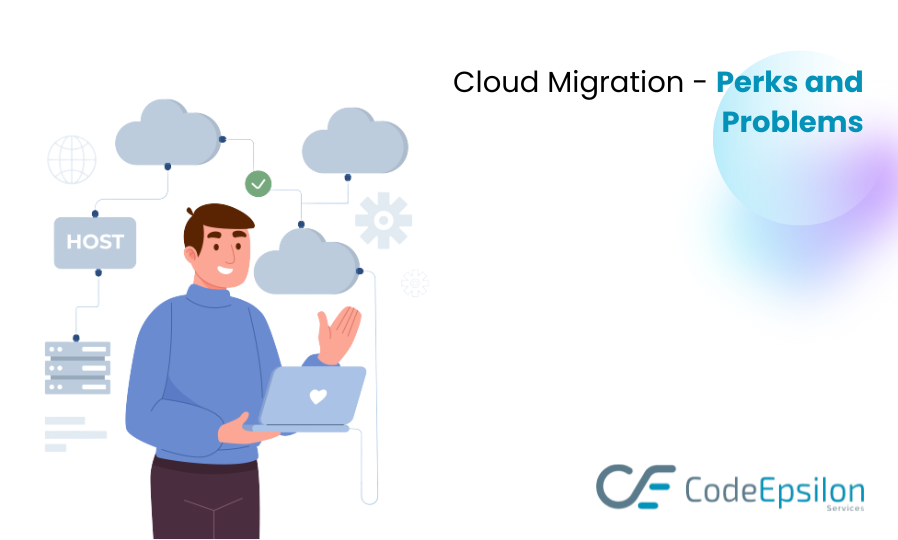
More and More companies are migrating to the cloud every day. Moving to the cloud has very high perks, containing better speed and time-to-market, better security, and lower operational expenses. However, cloud migration is a complex task. Before shifting to the cloud, companies should evaluate different cloud options that can match their scalability and flexibility requirements.
For companies making the initial migration to the cloud, there are some essential considerations to be familiar with, which you will understand from this piece of content.
What is Cloud Migration?
Cloud migration is when data workload is shifted from one infrastructure environment to another. The” Cloud” in cloud migration is a shorthand for the cloud computing environment. Cloud computing refers to data centers and services accessible to many individuals over the internet, allowing access to files and executing tasks from any facilitated computer or other devices. Cloud computing has been in this field for around so many decades. At this stage, customers use cloud computing probably all the time to check their emails, scroll social media, and chat via messaging applications.
Further, companies are increasingly shifting files, systems, and processes to the cloud. “The cloud” refers to data storage, resources, servers, and more available on-demand over the internet instead of managing, hosting, or maintaining physical servers. These abilities generally perform on the cloud-based infrastructure offered by a cloud services provider like Google cloud, AWS, OCI, or Azure. The cloud can be an optimal environment to increase stability, specifically during disruption. Therefore, knowing which workloads will gain the most perks if shifted out of the data center is wise.
The 6R’s of Cloud Migration
In the IT industry, there are significantly six methods of cloud migration:
Rehost
Rehost is also known as lift and shift; this kind of cloud migration directs to moving applications from an on-premises environment to the cloud in a comparatively concise manner.
Replatform
Replatform is like hosting, but few of the application’s components are replaced or retooled to reap more perks of cloud services.
Repurchase
Repurchase refers to decommissioning an application and replacing it with a cloud-based interpretation.
Refactor
It refers to re-architecting an application from the start to developing a cloud-optimized application from the foundation.
Retire
Retire directs to simply closing down a duplicative legacy application without shifting it to the cloud.
Retain
This kind of cloud migration is not a cloud migration, but preferably, choosing to stick with legacy on-premises services because it currently works perfectly.
Significant Perks of Cloud Migration
Flexibility and scalability
Cloud migration provides companies more flexibility to increase their server requirements as high and low as needed. For a similar reason, cloud services are more scalable and efficient than on-premises.
Lower cost
It can be more economical for companies to utilize cloud-based resources because they no longer need to procure and manage costly service infrastructure and IT teams to support them. Moreover, cloud services come with pay-per-use billing, which also optimizes costs. Cloud migration might come at an initial expense, but eventually, that cost will pay you back by reducing maintenance expenses.
Mobility
Cloud migration frees an enterprise from being docked to a data center and makes it possible to administrate from any corner of the world. At present, where remote work is becoming more of a benchmark, office mates must be independent of a workstation. Files and services stored in the cloud provide the benefit of working from anywhere, on any device, speeding up the work and obtaining quick results.
Security
The hazard of cybercrime against your cloud-based files is mostly a myth. The majority of cloud-based applications and platforms have robust in-built security mechanisms. Statistically, most of the data stealing occurs inside a company. Cloud migration to secure storage can be a powerful way to retain data and files. Cloud-based solutions generally provide faster data recovery in the event of any incident.
Common Problems Faced in Cloud Migration
Lack of strategy
Various companies begin cloud migration without considering the points of sufficient time and attention to their strategy. For the success of cloud adoption and implementation, end-to-end cloud migration planning is required. Cloud migration may need a different method and can be time-consuming based on the application and database.
Cost management
Various companies still need to develop accurate KPIs to describe how much they will save or spend after cloud migration. This factor makes it problematic to see whether migration was successful from an economic perspective. It is necessary to understand that the cloud environment can change quickly, costs can get higher as new services are adopted, and application utilization enhances.
Vendor lock-in
Cloud migration adopters often struggle with vendor lock-in. Vendor lock-in cannot expand most of the solutions provided by cloud providers to other cloud platforms. Thus, several organizations find it problematic to switch providers in case they fail to meet the current provider’s requirements.
Data Security and Compliance
One of the significant problems of cloud migration is data security and compliance. The data migration procedure itself depicts security risks. Shifting sensitive data across environments and configuring credentials authority for applications generates consequential disclosure.
Operation Disruption
The main obstacle here is continuing with migration with minimal disruption to regular operation, at the best lowest expenses, and over the shortest period. One of the most complicated factors of migration, specifically in large organizations, is driving and synchronizing significant volumes of data with less to no downtime. You risk affecting your business operations if your data becomes unreachable to users during cloud migration. The exact is correct as you sync and update your systems after the initial cloud migration.
Choose the Right Cloud Migration Partner
CodeEpsilon is the most potent multi-cloud data platform in the industry, bridging legacy, on-premises, cloud, and serverless data in real time, regardless of where your data is located. Whether an application is on-premises or in the cloud, there are always new issues for your company to conquer. We are here to help you throughout your cloud journey and beyond!
"It is not the strongest of the species that survives, nor the most intelligent, but the most responsive to change." Charles Darwin As technology advances at a breakneck pace, businesses that need to catch up in embracing digital transformation risk getting left behind by their competitors. Digital transformation integrates digital technology into all company surfaces,...
Flutter provides a wide range of layout widgets, such as Row, Column, and Wrap, which can be combined and customized to create responsive layouts. With widgets like `LayoutBuilder` and `MediaQuery,` developers can obtain information about the screen's size and orientation and use this data to adjust the layout and content accordingly. This flexibility is crucial for delivering a consistent user experience across different devices.

 Email
Email India
India USA
USA Email
Email